Hives are raised, itchy bumps on your skin that appear like a rash. They can last anytime from a few minutes to a few days. You can often treat hives yourself.
Check if you have hives
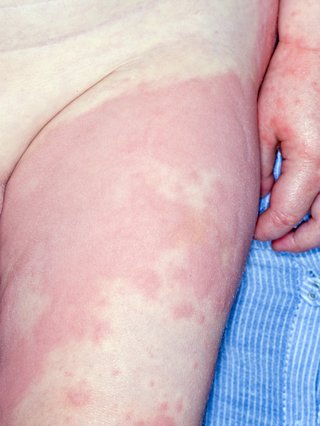
The skin on most of their thigh is pink, raised and bumpy. At the side of their thigh, close to their hand, are deep creases in the skin.
Their hand is pink with some red patches between their thumb and finger and on their fingertips.
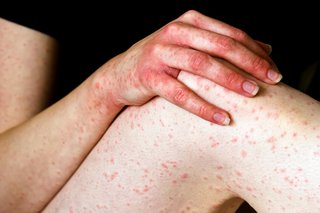
Small, slightly raised pink spots cover their leg. Some are close together and some are further apart.
The same spotty rash spreads along the side of their arm and across the top of their hand. The knuckles and fingertips are red.
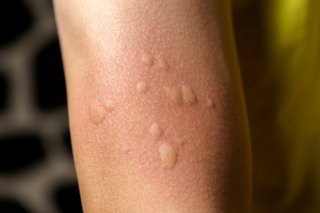
There are many skin-coloured bumps on and around the knee which vary in size from around 2mm to 1cm. The larger bumps look puffy like blisters. Some bumps are very close together in groups.
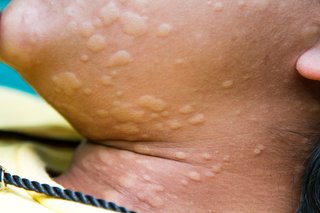
Some of the bumps are small circles and others are larger, uneven shapes. Most are close together in groups, but some are further apart. The bumps are a lighter brown than the surrounding skin and look puffy, like blisters.
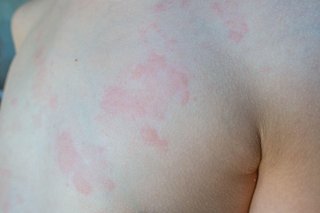
Some patches are close to or join others, while some are further apart.
Some patches are dark pink. Others are lighter pink with a darker pink border around the patch.
There's a long, dark pink patch spreading from their groin to their hip.
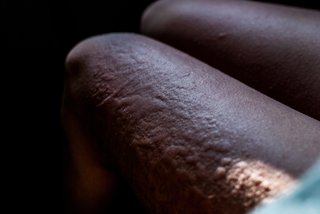
The skin near the left knee also has raised lines, like scars. The skin on the inside of the thigh is smooth.
The rash is the same colour as the person's skin.
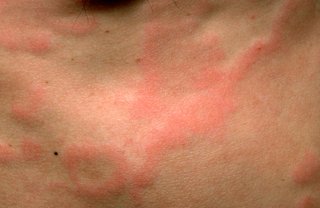
Hives can be different sizes and shapes, and appear anywhere on the body in both adults and children.
The rash is often itchy and sometimes feels like it's stinging or burning.
A pharmacist can help with hives
Your pharmacist can give you advice about antihistamine tablets to bring down your hives rash.
Tell your pharmacist if you:
- have a long-term condition
- are on any medicines - you might not be able to take antihistamines.
They also may not be suitable for young children under age 2. Ask your pharmacist for advice before giving your child any antihistamines.
Non-urgent advice: Contact your GP if:
- the symptoms do not improve after 2 days
- you're worried about your child's hives
- the rash is spreading
- your hives keep coming back – you may be allergic to something
- you also have a high temperature of 38 degrees Celsius or higher and feel generally unwell
- you also have swelling under the skin – this might be angioedema, a condition usually caused by an allergic reaction
Urgent advice: Go to your nearest emergency department or call 999 or 112 if you:
- have difficulty breathing
- have difficulty swallowing
- have dizziness or fainting
- are feeling sick or vomiting
- have an increased heart rate
- have rapid and severe swelling of the face, mouth or throat
These could be signs of a severe allergic reaction, such as anaphylactic shock.
Treatment for hives from a GP
Your GP may prescribe corticosteroids, menthol cream or stronger antihistamines.
If your hives do not go away with treatment, you may be referred to a skin specialist (dermatologist).
You cannot always prevent hives
Hives happen when something causes high levels of histamine and other chemicals to be released in the skin. This is known as a trigger.
Triggers can include:
- food
- pollen and plants
- insect bites and stings
- chemicals
- latex
- dust mites
- heat – work and sleep in a cool room and wear loose, lightweight clothes
- sunlight, exercise or water
- medicines – contact a GP if you have an allergic reaction
- infections
- emotional stress
Content supplied by the NHS and adapted for Ireland by the HSE
