
Spirometry is a test used to diagnose and monitor lung conditions including:
- asthma
- chronic obstructive pulmonary disease (COPD)
- cystic fibrosis
- pulmonary fibrosis
You breathe into a device called a spirometer. A spirometer measures how well air moves in and out of your lungs during forced breathing.
You have the test in either a hospital or community hub. You may be referred by your GP or a hospital doctor.
Why you may need a spirometry
Your GP or doctor may refer you for a spirometry because:
- you have symptoms of lung disease, such as a persistent cough or shortness of breath
- you are at risk of developing a particular lung condition
- you have repeated chest infections
- you smoke (either now or in the past)
- they want to check if you have a respiratory condition and see how serious it is
- you're on treatment and they want to see how you're responding
Preparing for the test
Talk to your doctor before your appointment if you use:
- inhalers
- nasal sprays
- antibiotics
- steroids
You may need to stop using your medicines before the test.
Don't
-
do not smoke for 24 hours before the test
-
do not drink alcohol 24 hours before the test
-
do not do strenuous exercise for a few hours before the test
-
do not eat a large meal for a few hours before the test
Do
-
wear loose, comfortable clothes on the day of the test
-
read the pre-test instructions on your appointment letter
-
arrive early so your breathing is relaxed
What happens during a spirometry test
A respiratory physiologist does the spirometry test. They will place a soft clip on your nose to stop air escaping from it.
They'll ask you to:
- Close your lips tightly around the mouthpiece.
- Inhale fully so your lungs are completely filled with air.
- Exhale as quickly and forcefully as you can, making sure your lungs are completely empty.
You'll repeat the steps at least 3 times to get a reliable result.
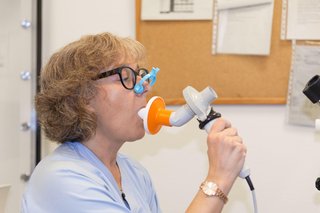
You can return to your normal activities after the test.
Bronchodilator test
In some cases you may need to have a test to see if your lung condition responds to bronchodilator medicine.
You’ll take some medicine using an inhaler to widen your airways, wait 15 minutes and then repeat the test.
Your results
Your results are compared against a typical range for someone of your age, height and sex.
Your doctor may refer you for other breathing tests. This could be to find out the exact cause of your lung problem. You may do these tests on the same day as your spirometry.
Risks or side effects
Spirometry is a safe test for most people. The test increases the pressure inside your head, chest, stomach and eyes as you breathe out.
The test usually causes no side effects. But you might feel dizzy, faint, shaky, or tired for a short time afterwards. If you have a condition that could be made worse by this, you may not be able to do the test.
For example, spirometry may not be safe if you have, or recently had:
- unstable angina
- a heart attack
- uncontrolled high blood pressure
- an operation to your head, chest, stomach or eyes
The physiologist will check if it is safe for you to do the test.
