
Warning notification:Warning

Unfortunately, you are using an outdated browser. Please, upgrade your browser to improve your experience with HSE. The list of supported browsers:

  1. Chrome
  2. Edge
  3. FireFox
  4. Opera
  5. Safari

Learn to control your breathing

Everyday activities can make you feel short of breath if you have COPD.

For example:

  • getting dressed
  • walking to the bathroom
  • doing jobs around the house

When you learn to control your breathing, your stamina will improve. You will then be able to do more before feeling short of breath.

Feeling short of breath may make you feel panicked or anxious. This can make your breathing worse.

When you feel short of breath try to:

  • stop speaking and moving
  • give yourself time to get your breathing back under control
  • relax or distract yourself by focusing on a picture or a view from a window

Managing shortness of breath is about controlling your breathing. You can do this no matter how fast or shallow your breath is.

Non-urgent advice: Talk to your doctor if you:

  • are finding it difficult to control your breathing
  • have feelings of panic or anxiety

They may refer you to a physiotherapist to help you to manage your shortness of breath.

How a physiotherapist can help

The physiotherapist will teach you different ways to help your breathing. This includes positions and breathing exercises to slow down your breathing.

The physiotherapist will also teach you techniques to help clear any phlegm if this is a problem for you.

Below are some of the techniques the physiotherapist may use.

Positions to help slow down your breathing

To start with, choose a position that makes it easier for you to breathe. It is important to try and relax in these positions. Focus on relaxing the muscles in your neck and shoulders.

Sitting leaning forward

Sit and lean forward resting your elbows on your knees or the arms of the chair.
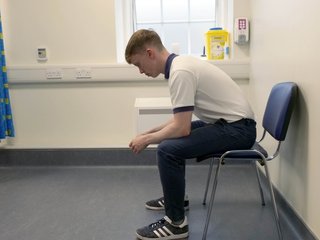
Image of a man leaning forward slightly in a chair and resting his elbows on his knees.
Sitting leaning forward can help you slow down your breathing.

Sitting leaning forward at a table

Sit and lean forward with your elbows resting on a table. You could put some pillows or cushions on the table for comfort.
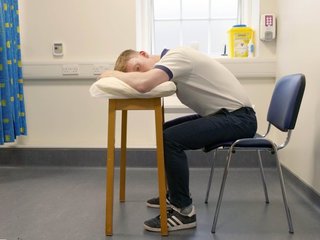
Image of a man sitting on a chair, leaning forward and resting his head sideways on a pillow.
When sitting leaning forward you can use a pillow on a table for support.

Standing leaning forward

Lean forwards resting your elbows on a chair, a wall or a railing. You could use a walking stick or a frame if you have one.

Your physiotherapist can teach you some breathing techniques.
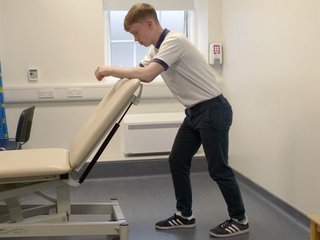
Image of a man leaning forward and resting his elbows on the back of a chair, with 1 foot in front of the other and bent knees
Use a chair to support your arms as you stand leaning forward.
Techniques to slow down your breathing

Learning some breathing techniques will help ease shortness of breath. It will also reduce the feelings of panic and anxiety that can come with breathing problems.

You can use these techniques in the position that you find most comfortable.

Pursed-lips breathing

This breathing exercise can be helpful when you feel you are breathing too fast. It helps you slow down your breath by making you breathe out for twice as long as you breathe in.

To do pursed-lips breathing:

  • sit in a comfortable position with your neck and shoulder muscles relaxed
  • breathe in slowly, if possible through your nose - as you inhale, count 1, 2
  • purse your lips in a whistling position
  • breathe out slowly for twice as long as you inhaled - as you exhale count 1, 2, 3, 4
  • relax and keep breathing steady
  • repeat these steps until you no longer feel short of breath
  • practice 4 to 5 times every day to retrain your breathing

Rest for a few breaths if you get dizzy. Start again when you are no longer dizzy.

Pursed-lip breathing (video)

Active cycle of breathing techniques (ACBT)

ACBT is a technique to remove phlegm from your lungs.

You can do ACBT in sitting, lying or side-lying positions. But start in a sitting position until you are comfortable and confident enough to try different ones.

ACBT includes a combination of:

  • gentle relaxed breathing - to ease shortness of breath
  • deep breathing - to move phlegm from the small airways at the bottom of your lungs to the larger airways near the top
  • the huff technique - to clear the phlegm

When you do ACBT, try to:

  • keep a good breathing pattern with relaxed shoulders and neck
  • breathe in through your nose and out slowly through your mouth - this can help reduce any wheezing

Gentle relaxed breathing

This breathing technique can help if you are short of breath after any activity. It can also help you feel more relaxed if you are feeling anxious or panicky.

Taking slower, deeper breaths from your tummy helps to ease shortness of breath.

Breathing from the tummy does not come naturally. You should practise it when you are not short of breath. This will help you master the technique.

To practise gentle relaxed breathing:

  1. Make sure you are in a comfortable position.
  2. Your head and back should be supported, and your shoulders and upper chest relaxed.
  3. Place 1 hand on your tummy.
  4. Feel your tummy rise and expand as you breathe in and relax down as you breathe out.
  5. Breathe gently when practising - there should only be a slight movement of your tummy at rest.

Tummy breathing technique (video)

Deep-breathing exercise

To practise deep breathing:

  1. Keep your neck and shoulders relaxed.
  2. Take a deep breath in through your nose or mouth so that your lower rib cage expands.
  3. Hold the air in your lungs for 3 to 4 seconds.
  4. Let the air out gently through your mouth.

Repeat this 3 to 4 times.

The huff technique

The forced expiratory technique is sometimes referred to as a ‘huff’. It is used to help force phlegm up the throat so you can get rid of it through your mouth without coughing. It can help to imagine you are steaming up a mirror in front of you.

To do the huff technique:

  1. Take half a deep breath in and huff the air out quickly, keeping your mouth open in an O-shape.
  2. As the phlegm moves into the larger airways take a deep breath in and huff it out again, keeping your mouth open in an O-shape.
  3. Continue huffing to clear the phlegm out of the back of your throat.

Other ways to clear mucus (phlegm) from your lungs

Some people with COPD produce a lot of mucus in their lungs. You may find it hard to clear it. This can cause extra distress and shortness of breath.

To help clear phlegm or mucus:

  • drink lots of fluids to keep the phlegm or mucus loose
  • use a reliever inhaler before trying to clear phlegm
  • do ACBT or huff breathing
  • exercise often, if you are able to

Important

Contact your GP if the colour of your phlegm or mucus changes. This can be a sign of infection.

Controlling shortness of breath at night

Some people with COPD may have breathing difficulties at night. This can be frightening. The anxiety can then make your breathing worse.

Sleeping upright using 4 to 5 pillows can make you feel more comfortable and less short of breath. It can also help to be prepared for shortness of breath at night.

To help control your shortness of breath at night:

  • use the pursed-lip breathing technique
  • relax your shoulders and neck muscles
  • keep your reliever inhalers beside your bed and use them if needed
  • keep a fan beside you and turn it on if you are short of breath - the sensation of moving air can help

If you wake short of breath, sit up and lean forward. For example, you can sit at the edge of the bed and lean on a bed table.

Check how short of breath you are

Some people with COPD can be breathless when they are not active. Other people only get breathless when they are active.

It is good to be aware of your own levels of breathlessness and the types of things that make you breathless.

Healthcare professionals use a scale called the BORG scale to keep track of levels of breathlessness.

The BORG scale helps you to track how hard you are working in all the tasks you complete every day. For example, you might be doing a housework task and notice that you are becoming short of breath.

You are the expert on your body and know it best. It is important that you know how to check your own energy and activity levels. You need to do this often.

The breathlessness scale starts at the number 0. This is where your breathing is causing you no difficulty at all. It goes up to 10, where your breathing is at its most difficult.

Use this scale to check and guide you as you exercise or do everyday activities. It’s important to take regular rests and stop before you get too short of breath.

Modified BORG Breathlessness Scale

  • 0 = nothing at all
  • 0.5 = very very slight (just noticeable)
  • 1 = very slight
  • 2 = slight
  • 3 = moderate
  • 4 = somewhat severe
  • 5 to 6 = severe
  • 7 to 8 = very severe
  • 9 = very, very severe
  • 10 = maximal

When to get medical help

Shortness of breath can sometimes be serious, and you'll need to get medical help.

Non-urgent advice: Call 112 or 999 if:

  • your chest feels tight or heavy
  • you have pain that spreads to your arms, back, neck and jaw
  • you feel sick (nausea), or are getting sick (vomiting)

You could be having a heart attack or other medical emergency.

Non-urgent advice: Contact your GP if

you have shortness of breath and:

  • your breathing changes from what is normal
  • it gets worse when you lie down
  • you have been coughing for 3 weeks or more
  • you have swollen ankles
Information:

Content contributed by the Irish Society of Chartered Physiotherapists

Page last reviewed: 21 January 2026
Next review due: 21 January 2029